Most towel buying decisions are made by touch: someone squeezes a sample, likes how plush it feels, and orders it. For a facility that launders towels hundreds of times a year, that instinct is misleading. The towel that feels best in the showroom is often not the one still absorbing sweat after eight months of daily washing. The spec that actually matters is durability under commercial laundering, and it is knowable before you order. Here is how to read wash-cycle life, weight, and blend so the towels you buy survive the laundry room instead of the sample table.
Start from the wash count, not the touch test
The single most useful number for an issued or member towel is how many wash cycles it survives before it has to be pulled. The spread here is wide and it maps directly to cost. Budget towels tend to fail somewhere around 50 to 100 washes, going thin, ragged, or non-absorbent. Hotel-grade goods typically last 150 to 200 washes. Quality commercial-grade gym towels are built to withstand 200 to 300 cycles, which in a busy facility works out to roughly eight to twelve months of continuous use. The chart below lays those bands side by side.
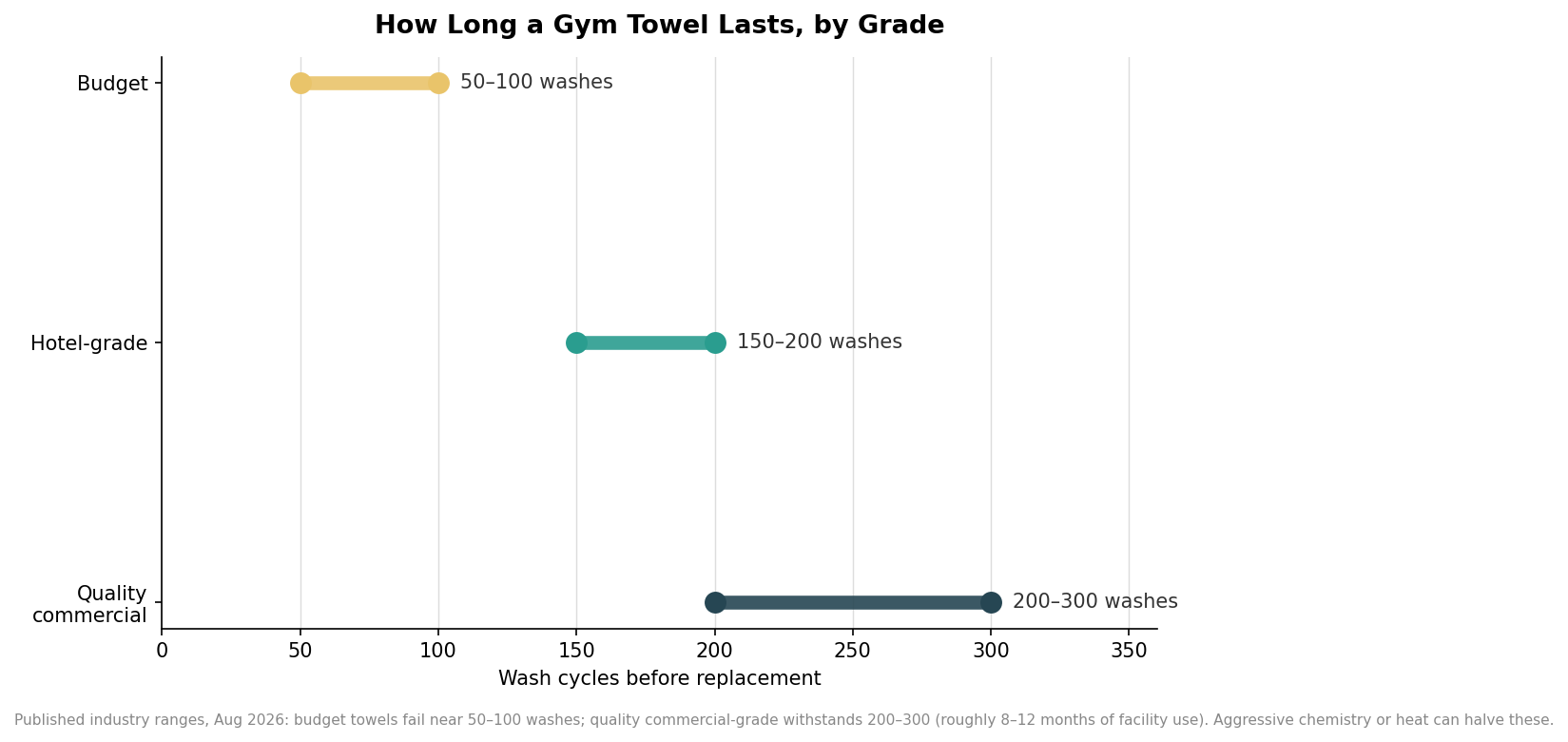
That range reframes the price conversation. A towel that costs less per unit but lasts a third as long is not cheaper; it is more expensive per usable month, and it generates more replacement labor and more laundry handling along the way. When you compare quotes, divide the unit price by the realistic wash-cycle life, not by the calendar, and the true cost ordering usually flips.
Weight and blend: what actually survives the wash
Towel weight is measured in grams per square meter, and for gym and sweat towels the useful window is fairly narrow. Below 400 GSM, towels feel thin and read as cheap to members, and there is less fiber to survive abrasion. Above 600 GSM, you are paying for weight that dries slowly and costs more to launder without adding much to a wipe-down towel. The commonly cited sweet spot is 450 to 500 GSM, dense enough to feel substantial and hold up, light enough to dry quickly between cycles. The chart below marks those zones.
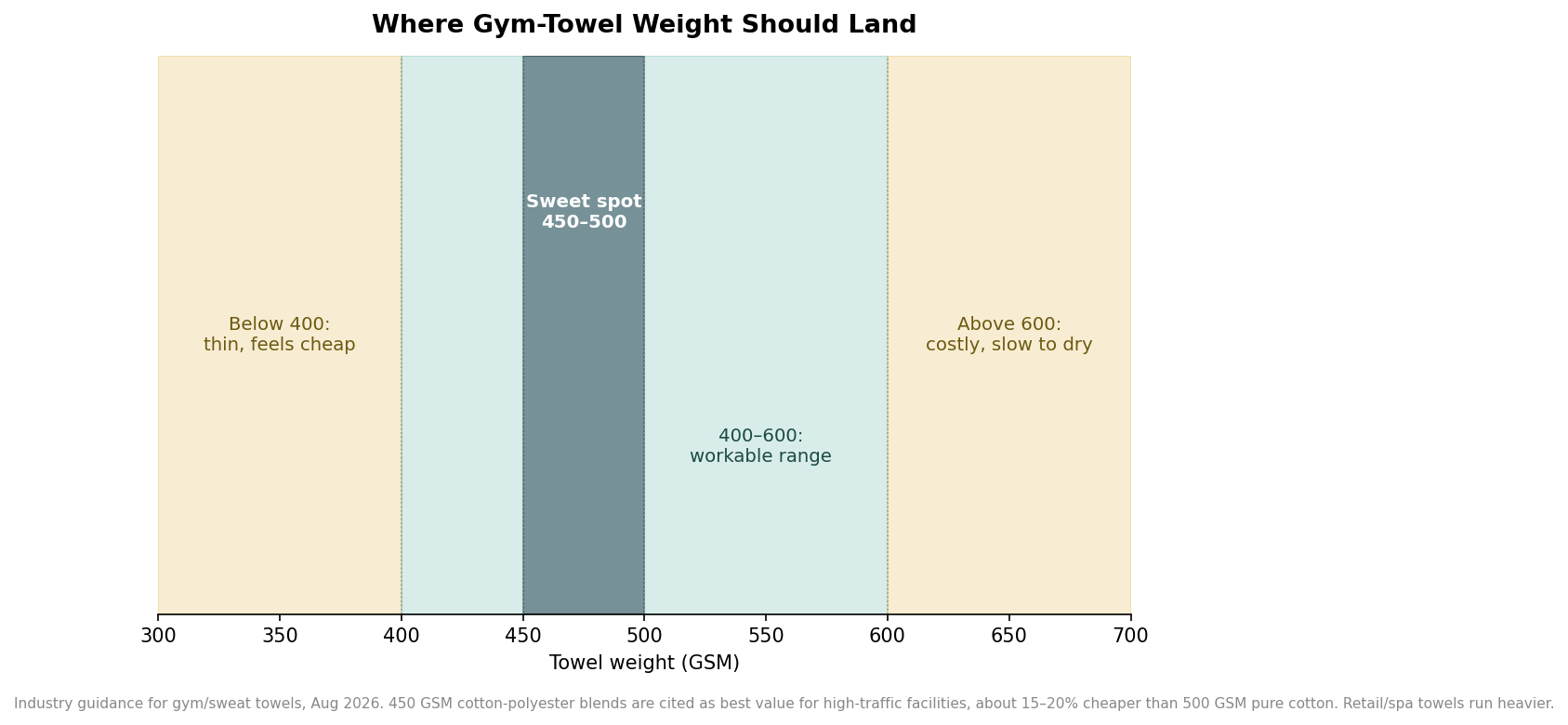
Blend matters as much as weight. Pure cotton feels plush and absorbs well, but a cotton-polyester blend around 450 GSM is frequently the better call for high-traffic facilities: the polyester adds tear and abrasion resistance where the towel takes the most stress, dries faster, and often runs roughly 15 to 20 percent cheaper than a 500 GSM all-cotton equivalent. The trade is a slightly less luxurious hand feel. For member-facing retail or spa lines where the towel is part of the experience, heavier all-cotton can be worth it; for issued sweat towels that live in a wash-dry-repeat loop, the blend usually wins on total cost and survivability.
The absorbency killers: softener, over-drying, and heat
A towel can look intact and still be functionally dead if it has stopped absorbing, and the causes are almost always in the laundry process rather than the towel itself. The biggest culprit is fabric softener. Softeners work by coating fibers in a thin waxy or silicone film, which is the opposite of what an absorbent loop needs; used repeatedly, they leave towels that feel soft but bead water instead of drinking it. The fix is simple and free: leave softener out of the towel wash entirely, and use a periodic hot rinse or a splash of white vinegar to strip any existing buildup.
Over-drying is the second killer. Excessive dryer heat and endless tumbling break down cotton fibers, so towels that are baked dry every cycle shed and thin faster. A useful internal standard is to replace towels when absorbency falls to about 70 percent of their original performance rather than waiting for visible holes; a towel that no longer wicks is failing at its one job even if it still looks presentable. New towels also need a break-in: cotton pile takes up to six wash cycles to fully bloom and reach finished size, so judge a towel’s real feel and absorbency after a week of laundering, not out of the plastic.
Wash temperature and the chemistry that shortens life
Hotter is not better. The industry-standard wash temperature for towels is around 140°F (60°C), which is the balance point that dissolves body oils, detergent, and bacteria while staying below the level that damages cotton. Push much past that toward boiling and you weaken the cellulose in the fibers, making towels brittle and prone to tearing, which is one of the fastest ways to cut a towel’s life in half. Heat also drives shrinkage: normal washing and drying costs about 4 to 10 percent shrinkage, but excessive heat can spike that to 10 to 15 percent and distort the towel into an hourglass shape. If you are handing a spec to a laundry, specifying the wash temperature and a no-softener rule protects the investment as much as the fabric choice does.
Speccing towels that go the distance
Put the pieces together and a durable gym-towel spec is not complicated. Target 450 to 500 GSM, lean toward a cotton-polyester blend for issued and member sweat towels, and ask the supplier for a wash-cycle durability figure, not just a weight, so you can compare like for like. Pair the goods with a laundry process that runs around 140°F, skips fabric softener, and avoids over-drying, and set a replacement trigger at roughly 70 percent of original absorbency. Because facilities routinely lose 10 to 20 percent of towel inventory a month to ordinary wear, plan par levels and reorders around that attrition rather than treating replacement as an exception. Every figure here is an indicative industry range and will vary by supplier, construction, and laundry practice; use them to write a spec that holds up, then confirm the specifics with your supplier and your laundry before you commit to a large run.